Presenting new research at the European Political Science Society Conference

I am looking forward to the first conference of the European Political Science Society (EPSS) in Belfast, 18-20 June 2026! Having put together the program for the Section on Conflict and Political Violence together with Monika Sus, I am very excited about all the interesting work that we will be able to see and discuss in Belfast.

I will also be presenting two projects with my wonderful co-authors, come and see us if you are at the EPSS conference:

“Symbols of Division: The Effect of Cultural Celebrations on Post-Conflict Tensions”, together with Marie-Therese Meye and Eline Drury Løvlien, 19th June 17:10-18:50, Hall 1D

“What if you take people down the slippery slope? A video experimental test of reactions to human rights arguments” together with Katrin Paula, Rob Johns and Nadine O’Shea, 20th June, 15:20-17:00, Hall 2A

Opening for a 1-2 year Alexander von Humboldt Fellowship

I am looking for a postdoctoral researcher to take a 1-2 year fellowship from the Alexander von Humboldt Foundation to carry out their own, theory-driven empirical research on the topics of peace and conflict, political violence or state repression. The fellowship may last from 6 to 24 months and can be divided into up to three stays within three years. 

The Fellowship includes the following benefits:

  • monthly fellowship rate of 3,000 EUR

  • monthly research allowance for travel 

  • moving expense allowance

  • family allowances

  • extensions for fellowship with children under 12 years of age

  • funding for German language classes

  • subsidies for medical insurance

  • incorporation into the extensive alumni network of the Foundation.

For more details about the fellowship, please the Alexander von Humboldt Foundation.

To be eligible 

  • you need to have a PhD in political science (received within the last 12 years)

  • you need to have an exceptional publication record

  • you need to have advanced quantitative research skills

  • you are not a German citizen and you do not have a degree from a German university or have previously had a longer research stay at a German institution.

Application procedure

If you are interested in this postdoc fellowship, please email me your cv and a 1-2 page summary of the research you intend to carry out during this fellowship and the envisaged starting date of this fellowship.

I plan to start online interviews towards the end of April 2026. I am also happy to meet with applicants during the EPSS Conference 2026.

New textbook on human rights

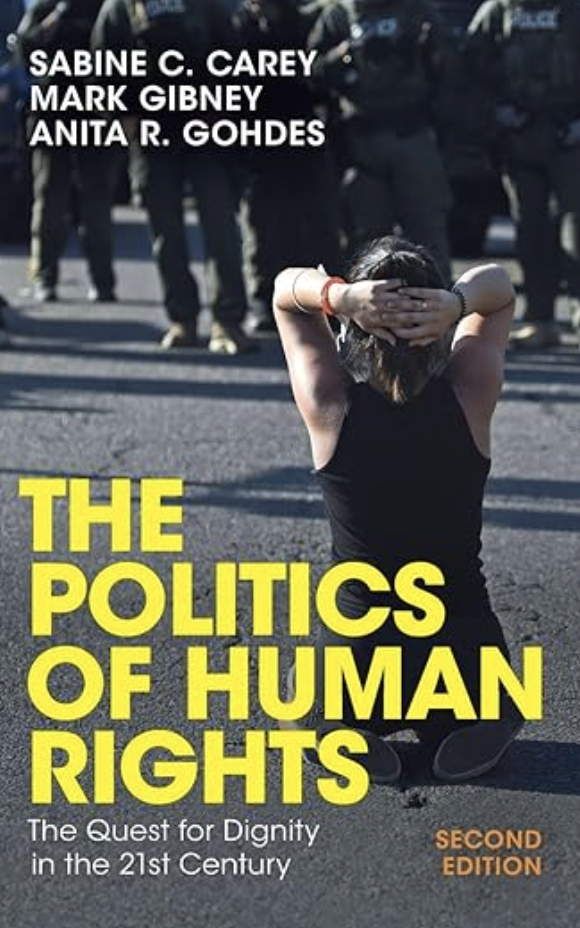
Fifteen years after the first edition came out, we finally have a completely updated and overhauled version of our textbook ready for you! We hope you will find it just as useful, or possibly even more so, than the first edition! Check out The Politics of Human Rights. The Quest for Dignity in the 21st Century.

Reviews and Endorsements

“The Politics of Human Rights offers an insightful and empirically grounded exploration of human rights, their violations, and the mechanisms designed to protect them. This revised edition integrates rigorous scientific analysis with real-world case studies, making it an invaluable resource for students, scholars, and practitioners. With its focus on the universal nature of human rights and the shared responsibility to uphold them, this book is an essential guide for understanding both the challenges and the progress in the fight for human dignity.” Bonny Ibhawoh - Senator William McMaster Chair in Global Human Rights, McMaster University

“This is an excellent introduction to the politics of human rights and what we know from existing research. It provides a framework to help readers understand how challenges to human rights arise, highlighting the specific actors and their choices, as well the scope for efforts to improve human rights.” Kristian Skrede Gleditsch - Regius Professor of Political Science, University of Essex & Research Associate, Peace Research Institute Oslo

“This book is a must-read primer on human rights, perfect for undergraduate courses, graduate seminars, as a comprehensive guide for scholars moving into studying human rights, and as a reference tool for scholars already studying human rights or repression. It expansively covers essential topics – the legal definitions of human rights, data collection on human rights violations, the causes of human rights violations, and the prevention of, and societal recovery from, human rights violations – but does so accessibly and with a myriad of engaging examples. The book also smartly engages a variety of critical contemporary issues, including the human rights of migrants, corporations and organized crime as human rights violators, police violence in the US in a human rights context, and many others. The chapter on human rights and the Internet is an incredible and compelling synthesis of a diverse set of sub-fields.” Jennifer Earl - Chair and Professor, Department of Sociology and Criminal Justice, University of Delaware

COM'LAB SciencePod

Science is often criticized as costly or unnecessary, but Sabine Carey shows that it is essential for progress, democracy, and our future. In an episode of the COM'LAB SciencePod, she highlights the importance of research for our society and its role in enabling well-founded decisions. She explains how scientific work provides long-term impulses for technological and social progress. The discussion makes clear that science funding should be seen in a more nuanced way and its value for democracy more strongly emphasized.

The COM'LAB SciencePod is a Trans­forMA project funded by the Bundes­ministerium für Bildung und Forschung (BMBF).

Event series "Democracy needs discourse" - contribution to kick-off event

It was a pleasure to participate in the first event of the series “Demokratie braucht Diskurs” (Democracy needs discourse), organized by the institutions of higher education. The first event took place at the University of Mannheim, moderated by Karsten Kammholz, Chief editor of the Mannheimer Morgen. I spoke about the link between democracy and human rights and the role of public opinion in this connection. My colleagues from the University of Mannheim, Prof. Dr. Svenja Behrendt, Dr. Philipp Müller and Prof. Dr. Heiko Paulheim highlighted different aspects of democracy, basic rights, the media and AI.